THE RHYTHMS IN RUNNING
In the world of running, rhythms (often also called gaits or steps) represent the speed at which a given distance is covered, usually expressed in minutes per kilometer (min/km). Properly managing rhythms is essential to avoid running out of energy too early, prevent injuries, and specifically stimulate the body's various energy systems.
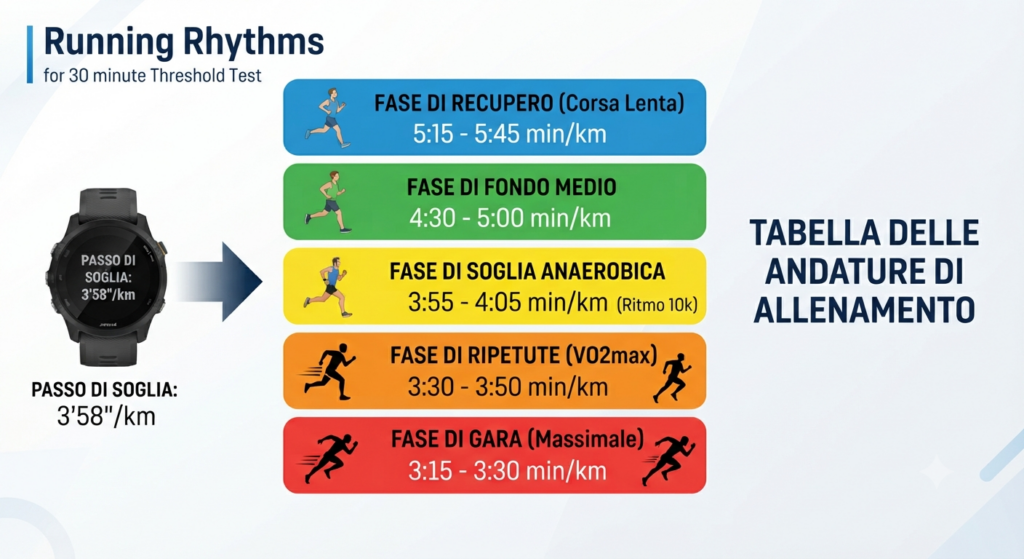
The main types of rhythm in training
Running rhythms aren't all the same; they're broken down based on the training objective and the athlete's physiology:
- Bottom Rhythm (Slow Race or CL):
- It's a very comfortable gait, where you can speak comfortably without having a wind.
- What it is used for: It is used for active recovery, to build the aerobic base and to accumulate kilometers without excessively stressing muscles and joints. It usually makes up 70-80% of a runner's total volume.
- Middle Rhythm (CM):
- A steady and challenging but sustainable gait, faster than slow bottom but below the anaerobic threshold. It requires concentration and your breathing begins to deepen.
- What it is used for: It improves the body's ability to use fats as an energy source and accustoms the body to disposing of lactic acid at medium-high speeds.
- Threshold Rhythm (CS):
- It corresponds to the pace that the athlete is able to maintain for approximately one hour of continued effort (or that obtained from specific tests such as the 30-minute test).
- What is it used for: It is the equilibrium point where lactic acid production and its disposal are equivalent. Training at this pace raises your “threshold”, allowing you to run faster with the same fatigue.
- Race Pace (RG):
- It is the specific speed you intend to maintain during a competition (be it a 5 km, a 10 km, a half marathon or a marathon).
- What is it for: Specific workouts aim to make this rhythm an automatism, accustoming the mind and muscles to sustain it throughout the race.
- Repeat Rhythm (or Interval Training):
- very fast speeds (above race pace over 10 km) maintained for short stretches (e.g. 400m, 1000m) alternating with recovery phases.
- What it is used for: Increases aerobic power, speed and the ability to tolerate extreme fatigue.
How do you determine your own rhythms?
To correctly set training rhythms without running “blindly”, three main methods are used:
- The field test: Like the 30-minute test or the 3 km/5 km test, which allow you to calculate the threshold step and derive all other gaits accordingly using conversion tables.
- The lactic acid test (or cardiovascular test): Performed in specialized laboratories with the analysis of exhaled gases or lactic acid levels in the blood.
- GPS devices and heart rate monitors: Modern instruments monitor pace per kilometer and heart rate in real time, helping the athlete stay exactly within the predetermined pace range for that session.
A cosa serve: Aumenta la potenza aerobica, la velocità e la capacità di tollerare la fatica estrema.






CONTATTI:
INFORMAZIONI:
Organizzazione no-profit dedicata alla promozione della corsa su strada, dell’inclusione sportiva e dell’esplorazione ecologica urbana di Roma